
A warm invitation
If you are reading this then perhaps you are curious, as we are, about how change actually happens, and how words that are easy to say like ‘hope’ can become embodied, grounded, practical – and practiced! – in our everyday lives.
We often hear talk of ‘hope’ and ‘change’ without the means to make it happen. This eight-part conversation series between the two of us – futures practitioner Bill Sharpe, and his friend and apprentice Yasu Mali – attempts to help you to become your own futures practitioner, equipping you with the knowledge and practices to begin shaping the world around you.
This series was recorded in Bill’s study in West Wales at an inflection point in each of our lives. The conversations were captured over a week together between walking the hills, reflecting on a lifetime of practice, and many cups of tea.
It is our sincere hope – there’s that word again! – that whoever you are, whether a seasoned practitioner or just getting started, that you find something of use here for you. We know that not everything will resonate, that’s okay! We offer these episodes in the spirit of shared learning, acknowledging that each change you make in your own life, community, organisational, national, or even global context, becomes part of this unfolding practice of patterning hope.
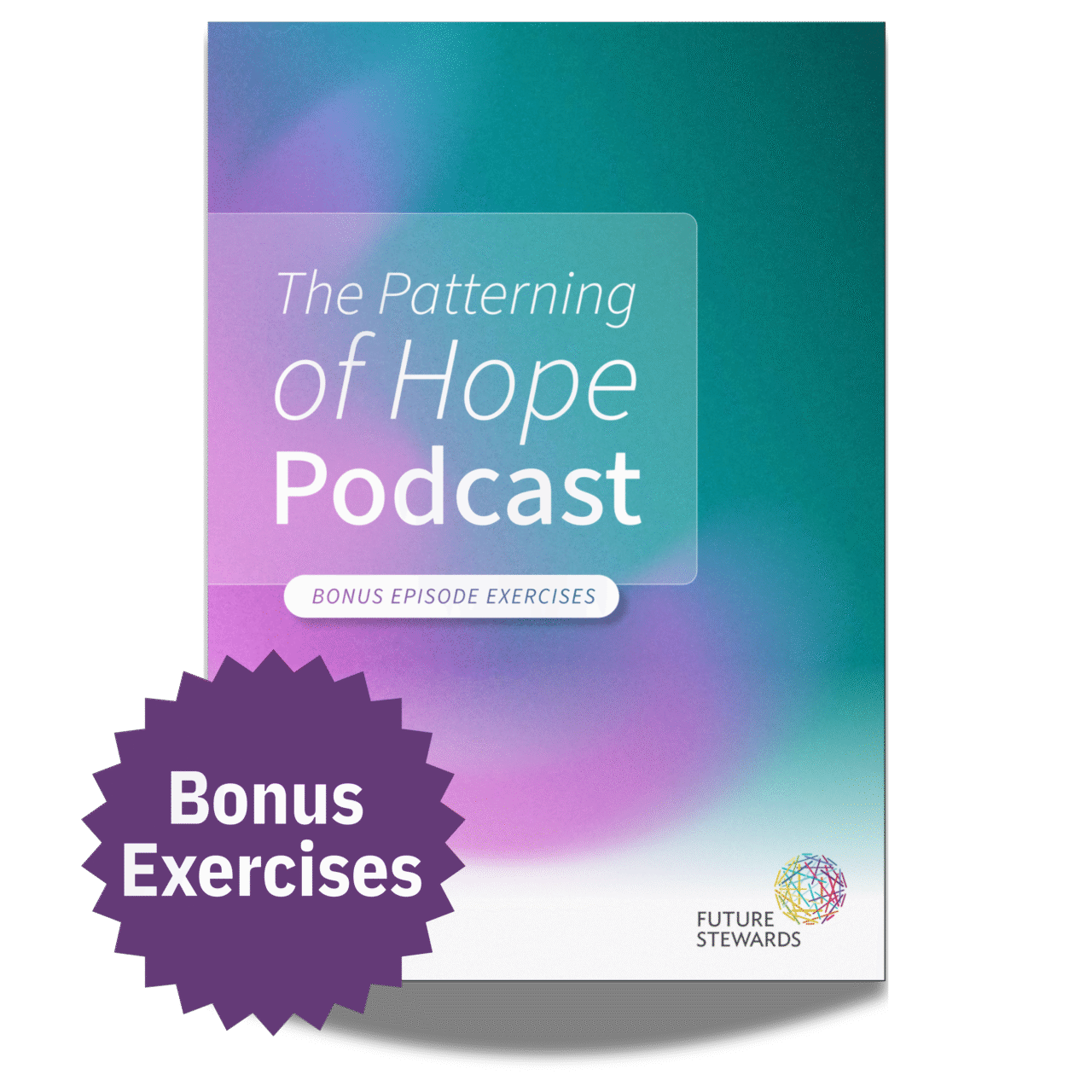
Each main episode is paired with a short bonus episode offering a simple practice you can try in your own life. If you really want to get stuck in, there is a free accompanying handbook to support the practices.
Thank you for joining us!
Love, Yasu & Bill

The podcast series and bonus episodes (released weekly):
Ep1: Three Horizons and 'The Patterning of Hope'
In this episode we talk about why we created this series, we give a brief introduction to the well-known systems change framework, Three Horizons, and how to understand the voices of the Three Horizons, and what we mean by H2+ and H2-. Bill also shares his third horizon vision for a shared cultural practice and what we mean by the patterning of hope.
Bonus 1: Identifying the Three Horizons
In episode one we introduced Three Horizons, which is the foundation for all the practices we’ll be discussing. So, if you haven’t already become familiar with it, take a little time to skip back and listen or watch the video introduction to Three Horizons which you can find in the show notes of episode one.
In this bonus episode Bill leads a simple exercise to help you identify the three horizons and their voices in your own life. As you listen you may wish to ‘pause’ the recording at different moments.
Bonus 1: Identifying the Three Horizons
In episode one we introduced Three Horizons, which is the foundation for all the practices we’ll be discussing. So, if you haven’t already become familiar with it, take a little time to skip back and listen or watch the video introduction to Three Horizons which you can find in the show notes of episode one.
In this bonus episode Bill leads a simple exercise to help you identify the three horizons and their voices in your own life. As you listen you may wish to ‘pause’ the recording at different moments.
Ep2: Seeing everything as patterns (holism with focus)
How does a tree become a tree? How did the internet become the internet? How does seeing in patterns help us effect change? In this second episode in The Patterning of Hope series, Bill and Yasu dive into the world of ‘structures and flows’, a core practice of seeing the world through a lens of interconnectedness.
Bonus 2: Seeing everything as patterns
One way to develop an understanding of patterns is by bringing both structures and flows into view. Structures are the stable things that configure flows – we see these easily. Flows are the processes that sustain those structures and change them over time – these are often less easy to see. In this bonus episode Bill shares a simple exercise for attuning to the structures and flows around you, called ‘holism with focus’.
For this exercise you’ll need at least 30 minutes, a pencil and paper, and somewhere outside where you can sit and draw a building or structure.
Bonus 2: Seeing everything as patterns
One way to develop an understanding of patterns is by bringing both structures and flows into view. Structures are the stable things that configure flows – we see these easily. Flows are the processes that sustain those structures and change them over time – these are often less easy to see. In this bonus episode Bill shares a simple exercise for attuning to the structures and flows around you, called ‘holism with focus’.
For this exercise you’ll need at least 30 minutes, a pencil and paper, and somewhere outside where you can sit and draw a building or structure.
Ep3: Identifying ecosystems for change
If everything is connected, how do you work with an ecosystem at the scale of change you wish to create? What’s a focal offering and how can we learn about creating one from Bill’s story of the humble pocket calculator? In this third episode in The Patterning of Hope series, Yasu and Bill explore these questions as well as the importance of shifting from focussing on problems to what matters within an ecosystem
Bonus 3: Exploring ecosystems
In episode three we talked about seeing the patterns of life as ecosystems. If you haven’t already done so, you might want to go back to the bonus episode 2 on structures and flows – this gives you the underlying view on how ecosystems come into being and will help with this practice.
Bonus 3: Exploring ecosystems
In episode three we talked about seeing the patterns of life as ecosystems. If you haven’t already done so, you might want to go back to the bonus episode 2 on structures and flows – this gives you the underlying view on how ecosystems come into being and will help with this practice.
Ep4: Time, Imagination and Future Consciousness
Could future consciousness be understood as being a memory of the future? In this fourth episode in The Patterning of Hope series, Yasu and Bill explore the power of imagination in supporting life to unfold in new ways, working with the potential of the present moment. They also discuss if there is an optimal timescale for dreams and visions, how to attune to the timeline for our ambitions, and how looking back can help us look forward. Plus how old Bill thinks he will be when his dream comes to life!
Bonus 4: Three qualities of time
The core idea of three horizons is to shift from our simple one dimensional view of time stretching into the future and instead adopt a three dimensional view in which we are aware of each horizon as a distinct quality of relationship between the future and the present, we call the move into this multi-dimensional view, and the skill to work with it, the step into future consciousness.
In this fourth bonus episode, Bill shares a simple exercise to explore qualities of time so that you can be sensitive to them in using Three Horizons – they will help you see what sort of decision and action you are working with.
Bonus 4: Three qualities of time
The core idea of three horizons is to shift from our simple one dimensional view of time stretching into the future and instead adopt a three dimensional view in which we are aware of each horizon as a distinct quality of relationship between the future and the present, we call the move into this multi-dimensional view, and the skill to work with it, the step into future consciousness.
In this fourth bonus episode, Bill shares a simple exercise to explore qualities of time so that you can be sensitive to them in using Three Horizons – they will help you see what sort of decision and action you are working with.
Ep5: What’s love got to do with it?
In this fifth episode in The Patterning of Hope series, Yasu and Bill’s conversation takes them on an unexpected turn, right into the heart of love.
They cover the art of facilitation as setting up a field of consciousness in which something emergent can manifest, the importance of words to Bill and the meaning we make as we live them, the patterns that we stand for and the freedom we have to make small or big acts that stand apart from the current patterns of our lives. They also discuss working with challenges, how we can show up to our work, and dealing with stage fright.
Bonus 5: Mutual Qualities of Life
Our discussion in episode 5 lies at the heart of our journey, exploring what it’s like to live life in the moment, being ourselves while being part of the community of life in which we find ourselves. Every moment has significance for us, and for the lives around us, and we only get to do it once, without rehearsal.
In this fifth bonus episode, Bill shares one of the core practices for bringing this quality of mutuality to life and applying it to our challenges. You will need a quiet place to sit and visualise.
Bonus 5: Mutual Qualities of Life
Our discussion in episode 5 lies at the heart of our journey, exploring what it’s like to live life in the moment, being ourselves while being part of the community of life in which we find ourselves. Every moment has significance for us, and for the lives around us, and we only get to do it once, without rehearsal.
In this fifth bonus episode, Bill shares one of the core practices for bringing this quality of mutuality to life and applying it to our challenges. You will need a quiet place to sit and visualise.
Ep6: Dilemma navigation: being as self and being as part of the whole
What is a dilemma? In this sixth episode in The Patterning of Hope series Yasu and Bill discuss how to distinguish between a choice and dilemma, and how dilemma thinking connects to Three Horizons.
They also cover how to identify value tensions between the first and third horizons and how to look for the positive value in each. Plus Yasu plays around with dilemmas to solve her family holiday dispute!
Bonus 6: Dilemma Thinking
Dilemma thinking is a way of approaching the practical challenge of moving from unproductive, polarised arguments into creative action.
In the show notes for episode 6 you’ll find links to a detailed tutorial, a video and facilitation guides. In this sixth bonus episode, Bill shares a simple awareness practice to help you begin recognising dilemmas in your own life.
Bonus 6: Dilemma Thinking
Dilemma thinking is a way of approaching the practical challenge of moving from unproductive, polarised arguments into creative action.
In the show notes for episode 6 you’ll find links to a detailed tutorial, a video and facilitation guides. In this sixth bonus episode, Bill shares a simple awareness practice to help you begin recognising dilemmas in your own life.
Ep7: Transformation: imaginal cells and shifting patterns
In this seventh episode in The Patterning of Hope series, Yasu and Bill explore the “hungry caterpillar” of transformation.
They discuss how to bring about change, looking at the three stages of change (envision, enrol, mobilise). How to think about minimum viable patterns, and. value constellations. Plus Bill’s (revised and more poetic) definition of transformation.
Bonus 7: Creating an MVP (Minimum Viable Pattern)
When we’re trying to bring about change we look for the simplest pattern that we have the power to embody in relationship with others to get change underway – we often call this establishing the Minimum Viable Pattern. In this seventh bonus episode Bill shares a practice for getting this process of change underway.
Bonus 7: Creating an MVP (Minimum Viable Pattern)
When we’re trying to bring about change we look for the simplest pattern that we have the power to embody in relationship with others to get change underway – we often call this establishing the Minimum Viable Pattern. In this seventh bonus episode Bill shares a practice for getting this process of change underway.
Ep8: A universal practice: an invitation to ‘pattern hope’
In this final episode in The Patterning of Hope series, Yasu and Bill discuss how the practice of transformation can be likened to that of democracy or language. What Bill is working to ignite around a movement of collective transformation.
Plus we hand you an invitation and permission slip to pick up these practices and make them your own!
Bonus 8: The Patterning of Hope
The patterning of hope is our capacity to bring our unique potential into the renewal of the patterns of life. In this final bonus episode in The Patterning of Hope series, Bill brings all that we’ve covered together in a simple exercise to explore the patterns of hope and renewal in your own life.
As Bill says “To hope is to change our experience of the present moment into one of life, to renew the human where we are, and as such is to experience life even in the presence of death of ourselves and others.”
Bonus 8: The Patterning of Hope
The patterning of hope is our capacity to bring our unique potential into the renewal of the patterns of life. In this final bonus episode in The Patterning of Hope series, Bill brings all that we’ve covered together in a simple exercise to explore the patterns of hope and renewal in your own life.
As Bill says “To hope is to change our experience of the present moment into one of life, to renew the human where we are, and as such is to experience life even in the presence of death of ourselves and others.”